Foundational Knowledge
Foundational Knowledge
What is foundational knowledge and why does it matter?
Foundational knowledge refers to the securement of five specific building blocks of learning that must be explicitly taught and practiced until they become automatic:
- Executive function which involves the ability to focus and remember information and follow instructions.
- Communication and language which includes high-quality interaction and the development of a rich vocabulary.
- Early reading which is composed of decoding and comprehension and the recognition of phonemes.
- Early writing which focuses on transcription and including letter formation and spelling.
- Early mathematics which focuses on mathematical ideas, skills and concepts such as number sense, patterns, shape recognition and key number facts.
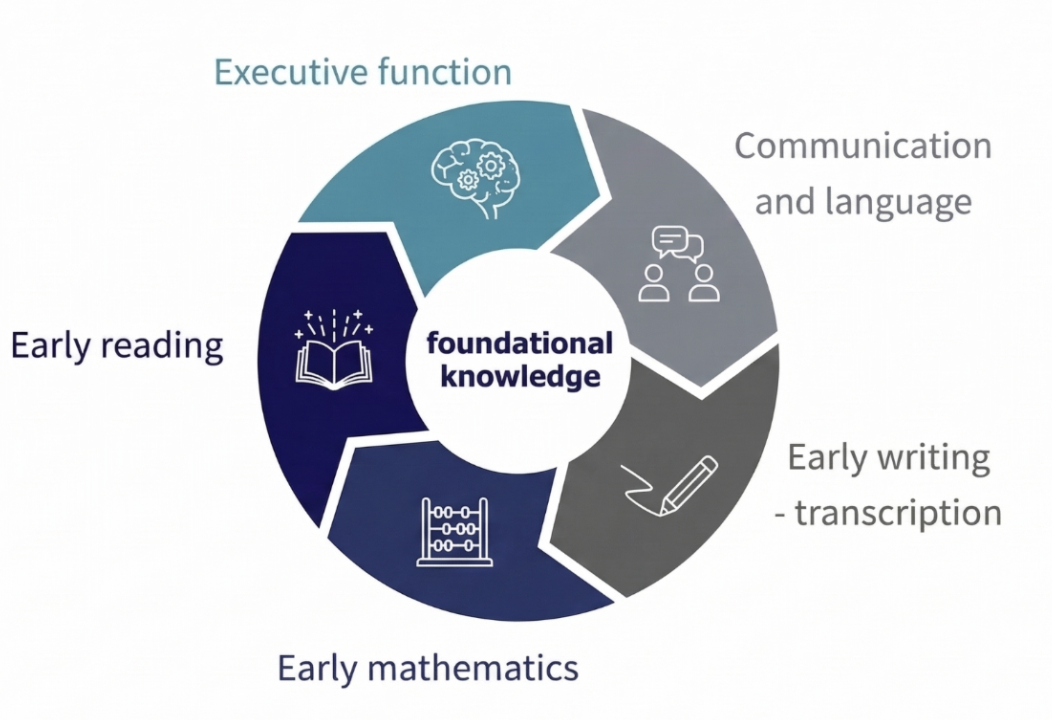
The Early Years Foundation Stage (EYFS) is of the highest importance within our school because it establishes the start of this journey; high-quality early education provides the necessary foundations for all later academic achievement and well-being. Securing this foundation is critical because it prevents "working memory overload" and allows children to focus on more complex tasks such as reading for comprehension or creative composition and as they progress to Key Stage 2. Without these firm beginnings, gaps in learning tend to widen over time and make it increasingly difficult for pupils to access a broad curriculum and achieve long-term success.
Foundational Knowledge
Executive Function
Executive function is a foundational pillar of knowledge that serves as the brain’s command centre. It provides the essential mental framework children need to manage their thoughts, actions and emotions, allowing them to develop positive attitudes toward their learning. These skills are not only important for success in school but also for children’s everyday life in order for them to be able to manage time, control emotions and adapt to new situations.
This system is comprised of three core areas:
- Inhibition: The ability to focus attention on what matters and screen out anything that is not relevant.
- Working Memory: The capacity to hold information in mind in order to work on it or follow multi-step tasks.
- Cognitive Flexibility: The ability to stay focused on a goal and work out when it is necessary to change approaches to achieve it.
Whilst we are born with the capacity to develop these skills, it is not an automatic process: executive functioning skills require practice. Teachers teach children to build the executive function skills that support a positive approach to learning. In school, we move children from high-quality adult support towards independent fluency by treating executive function as a deliberate and essential part of our curriculum. Staff encourage children to concentrate on what is important, ignore distractions, keep key information in mind while working and stay focused on a goal while recognising when they need to adjust their strategy to reach it. This development is supported by our provision, which places significant value on a clear learning environment strategy where the physical space, resources and daily structures are carefully designed to establish clear expectations.
We enable executive function through a range of strategies including: explicit teaching of critical thinking, modelled steps to success, dual coding, chunking lessons, learning strips, visual timetables and cooperative learning structures.
Communication and Language
Effective communication and language development are the vital foundations for our children. Throughout our Inspire curriculum framework, we make reference to the importance of language and oracy as essential tools to equip learners with the lifelong dispositions and specific knowledge required to make sense of the world and extend meaning beyond and between subject disciplines. Staff ensure every child receives purposeful, high-quality interactions that accurately respond to their individual progress and guarantee they learn exactly what they need through both planned and incidental moments. We focus on building a rich vocabulary through the repeated sharing of stories, rhymes, and songs, as the language found in books is often broader and more complex than everyday conversation. By ensuring that foundational language and "oral composition" are secured before moving to complex tasks, we give every child the tools they need to access a broad and balanced curriculum in later years. The Inspire Oracy Framework shares a clear progression from nursery to year six to ensure that the children develop their in oracy skills. This enables them to become more effective speakers and listeners and empowers our children to better understand themselves, each other and the world around them. We prioritise explicit vocabulary teaching by ensuring children are secure with common exception words, tier 2 words, national curriculum statutory words and root words.
Early Writing - Transcription
We recognise that learning to write requires a carefully sequenced approach to manage the cognitive load placed on young learners. We prioritise building a strong foundation in the two distinct pillars of writing (transcription and composition) in the early years by teaching them separately. To ensure transcription skills become automatic and effortless, we provide daily, explicit instruction starting from the very beginning of reception. This frees up a children’s working memory to eventually concentrate on the creative aspects of their writing.
We place a high value on oral composition, encouraging children to articulate their ideas and construct well-formed sentences out loud before they are expected to record them on paper. In order to bridge the gap between spoken and written language, we use dictation as a key practice tool. We understand that dictation is the writing equivalent of decodable books.
Both handwriting and spelling (transcription) are taught discreetly. We provide precise instruction on posture, pencil grip and letter formation to ensure writing is fluent and sustainable. We also emphasise the teaching of spelling. Spelling is a fundamental aspect of literacy that plays a critical role in pupils’ overall language development. It not only aids in reading and writing proficiency but also supports the acquisition of vocabulary and the ability to communicate effectively. As outlined in the national curriculum, a strong foundation in spelling is essential for children to become confident and competent in their use of language. The spelling progression map provides a clear, structured pathway for teaching spelling across our schools. It is designed to offer consistency and coherence in spelling instruction, ensuring that all children receive high-quality, sequential teaching that builds on their prior knowledge and skills.
Early Mathematics
We prioritise the development of procedural fluency and conceptual depth by following a highly structured and well-sequenced maths curriculum. We ensure that early mathematics is focused on securing the foundational knowledge children need, such as subitising and an automatic recall of number bonds. We know that providing pupils with the efficient, accurate recall of core number facts and procedures is essential for fluency, as this automaticity intentionally frees their minds to think deeply about more complex mathematical concepts and problems. We ensure that our children are secure with the underlying facts as we recognise that fluency demands a genuine grasp of mathematical structures rather than just rote memorisation. By identifying and addressing any gaps in knowledge immediately, we provide all children with the strong foundations required for their future educational success. Fluency ensures children have the flexibility to move between different contexts and representations of mathematics, to recognise relationships and make connections, and to choose appropriate methods and strategies to solve problems. We place emphasis on the explicit teaching of times tables, recognising that rapid recall of multiplication facts is a building block for later success in areas like fractions and ratio. By ensuring these facts are deeply embedded in long-term memory, we reduce the cognitive load on our children when facing more complex mathematical problems.
Early Reading
The teaching of Systematic Synthetic Phonics (SSP) is delivered through the Little Wandle Letters and Sounds Revised programme. Phonics is taught daily in Reception and Year 1. Children in Reception are taught to read and spell words using Phase 2 and 3 GPCs, and words with adjacent consonants (Phase 4) with fluency and accuracy. Children in Year 1 review Phases 3 and 4 and are taught to read and spell words using Phase 5 GPCs with fluency and accuracy. Effective assessment every six weeks, as well as assessment within the daily lesson is essential to identify children in Reception and Year 1 who need either individual or group Keep-up sessions. Daily Keep-up sessions ensure that no child falls behind in their phonics learning. These sessions are designed to provide targeted support to children who may need additional practice to consolidate their understanding of phonemes, blending, and word recognition. Alongside phonics lessons, children should also have weekly opportunities to apply their knowledge and skills to reading decodable books to an adult.